
Zohran Mamdani Family History
Overview

Zohran Kwame Mamdani was born on October 8th, 1991 to the academic Mahmoud Mamdani and his filmmaker wife Mira Nair in Kampala, Uganda. He was their only child.
When he was seven years old, he moved to New York City. Both his parents were professionals and he felt that his lifestyle there was privileged. He graduated from the Bronx High School of Science and received a bachelor’s degree in Africana studies from Bowdoin College in Maine in 2014.
He first involvement after college was in rap. He composed, performed, and produced rap music. Indeed he came up with the rap soundtrack for his mother’s 2016 film Queen of Katwe.
Political Involvement. Around that time he learnt that Ali Najmi was a fan of rap. So in 2015 he volunteered in the political campaign for his election to the City Council. In 2017 he joined the New York City chapter of the Democratic Socialists of America (DSA). He then worked on behalf of a Pro-Palestine candidate for the City Council.
In 2019 Zohran announced his own political campaign – to represent New York’s 36th State Assembly district taking in Astoria and Long Island City in Queens. He was endorsed by the DSA and ran on a platform of housing reform, police and prison reform, and public ownership of utilities. To general surprise he won the June 2020 primary against a five-term Democratic incumbent.
Then in 2024 he announced his candidacy for Mayor of New York. He won the Democratic primary in June 2025, defeating former governor Andrew Cuomo in an upset, and was elected mayor in the November election. He became New York’s first Muslim and first Asian American mayor.
Zohran Mamdani seems to represent a new breed of politician, in style and in substance. This is coming at a time when the old forms of politics are losing their appeal.
The Mamdani Name
During the Mughal Empire in India of the early 1530’s, there was a select group of Islamic scholars who had the task of managing money. They were mostly in charge of handling the amdani, the Urdu dialect for money or income. A number of them took up the last name of Mamdani, derived from the prefix mai (Urdu dialect for me) and amdani (money).
This Mamdani surname cropped up among the Khoja Muslims of Gujarat in India. The Khoja communities there traced their descent from the Prophet but functioned socially more like the Hindu caste trade guilds. Mobility was their weapon. When trade dried up, they migrated. They owed their allegiance not to a nation but to their trade network.
Muhammad Ali Jinnah, the founder of Pakistan, came from this same Khoja lineage. His ancestors were Gujarati Hindus who had turned to Islam when they were expelled from their guilds for trading in forbidden goods such as fish. Even at his death, nobody knew whether Jinnah was Sunni or Shia. That ambiguity, born of Gujarati mercantile pragmatism, would define this Muslim trading line.
The Mamdani numbers are not that large today. Most are in India. But the name has spread to Pakistan, Africa, England and America.
Indian Heritage
Both of Zohran’s parents are of Indian descent.
Paternal Side. Ratansi Mamdani, the first of Zohran’s paternal line, was a Muslim merchant trader in Gujarat in the mid/late 19th century. His descendants were to be found in Africa and later in America.
Maternal Side. Zohran’s mother Mira was descended from Punjabi Hindus from Lahore. She described her father Amrit Lal Nair as “a true Lahori.”
But Lahore is now Pakistan. And partition for many Hindus in 1947 meant abandoning their generational home and crossing the border for a new life in a new India. His own family name, originally Nayyar, became Nair.
After Indian independence Amrit Lal Nair was appointed the 1949 batch IAS (Indian Administrative Service) officer for Odisha, formerly Orissa, a state on India’s east coast.
Mira herself was born in 1957 in Odisha and grew up in its capital city of Bhubaneswar. But being the youngest child of the family and female, she did not feel that she got much respect from her father.
Her mother Praveen, a social worker, was more supportive. Mira remained closer to her mother after her parents separated in the 1990’s. She and Mira had co-founded in 1988 the Salaam Baalak Trust, a charity which supports street children in India.

Mira had received a topnotch education, first at Miranda House in Delhi and then at Harvard University in America where she had been accepted under a scholarship.
Her subsequent career as a documentary and features filmmaker built on what she had learnt in America. Her films, mainly covering Indian themes, won international renown. The Indian Government recognized her contributions to cinema and society with the Padma Bhushan in 2012, India’s second-highest civilian honor.
Africa and America
The Mamdanis in Africa. It was Kermalli Alibhai, a grandson of Ratasni Mamdani the Gujarat trader, who emigrated to East Africa in 1905 from a small village near Jamnagar when he was sixteen years of age. Over time he built up several successful businesses in Dar es Salaam in the British colony of Tanganyika. His son Yusuf Karmalli Alibhai was born there in 1922.
In 1945 this Yusufbhai married Kulsum Panju from the Tanganyika–Congo border. Her Indian family had come to East Africa earlier, in the late 1800’s.
Some years after their marriage Yusufbhai lost his job as a manager of a cotton ginnery. He had refused to falsify to his company’s advantage the weights on the cotton that he purchased from farmers.
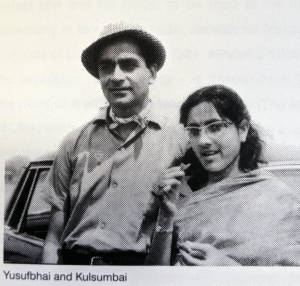
In 1951 the young couple moved from Dar es Salaam to Uganda in order to start a new life. Yusufbhai settled in Kampala and found work in Nabugabo. From a modest beginning he became a connoisseur of Persian carpets and then set up a foam factory on the Kampala-Masaka Road.
He like other Asians was expelled from Uganda in 1972. He and his family found a home in London at that time. They returned to Kampala on the fall of Idi Amin seven years later. Yusufbhai lived on until 2014. His death was much lamented. Outside of his work, he had been a poet, writer and an organiser of his community.
Mahmoud and Mira. His elder son Mahmoud was the brainy one who attended college in America and became an academic professor.
Mahmoud first met Mira, his wife-to-be from India, in Nairobi, Kenya in 1989 when she was doing research for her film Mississippi Masala. She had read his book From Citizen to Refugee about the expulsion of Asians from Africa where Mahmoud had a direct experience. Her film would tell a similar story. Soon she moved in with him on the campus at Makerere University in Kampala where he was teaching. They married in 1991.
In 1996 they moved to Cape Town in South Africa for Mahmood to take up an appointment as head of the African studies program at the University of Cape Town. They lived there for three years before moving to America.
America. Both Mahmoud and Mira had early experiences of America.
Mahmoud was one of twenty-three Ugandan students in the 1963 group of the Kennedy Airlift, a US-funded scholarship program that brought hundreds of East Africans to universities in the United States and Canada between 1959 and 1963. Mahmoud graduated with a Bachelor of Arts degree from the University of Pittsburgh in 1967.
Mira meanwhile was awarded a scholarship to Harvard University in 1976 at the age of nineteen. There she pursued a concentration in Visual and Environment Studies with a particular focus on documentary filmmaking. It was at Harvard and later in New York where she first developed her skills as a documentary filmmaker.
In 1981 she married an American, the photographer and writer Mitch Epstein whom she had first met at Harvard and later worked with. But that marriage did not last. They divorced in 1989.
Around 1999 Mahmoud and Mira moved to America when Mahmoud joined the faculty at Columbia University and they settled with their son Zohran in New York.

As of 2026 they were living in the Morningside Heights neighborhood in Manhattan, close to Columbia University.
Zohran Mamdani’s Family Tree
- Paternal Line
- Kermalli Alibhai (1889-1958), the grandson of Gujarat merchant trader Ratansi Mamdani, moved to East Africa in 1905 and m. Ladhibai Jeevan Rajan
- – Yusuf Karmalli Alibhai (1922-2014), moved to Kampala
- – Allarakhia Alibhai (died in 2009), remained in Dar es Salaam
- – Mohamed Alibhai (died in 1995), moved to Canada
- Yusuf Kermalli Alibhai born in Dar es Salaam, Tanganyika (now Tanzania) m. Kulsum Panju (1927-2003) in 1946. The couple moved to Bombay while Yusufbhai attended college there and then relocated to Kampala, Uganda in 1951. They remained in Kampala, apart from a period in exile when Idi Amin ran the country.
- – Mahmoud Mamdani (b. 1946), academic
- – Anis Mamdani, businessman in Kampala and Dar es Salaam
- – Masuma Mamdani, public health specialist in Dar es Salaam
- Mahmoud Mamdani m. Mira Nair, filmmaker, in Kampala, Uganda in 1991 They moved to New York in 1999.
- – Zohran Mamdani (b. 1991)
- Zohran Mamdani m. Rama Duwaji, illustrator and ceramist from a Syrian immigrant family (b. 1997) in New York in 2025
- Maternal Line
- Amrit Lal Nair, Indian civil servant from Punjab in Odisha (1923-2014) m. social worker Dr. Praveen (Didi) Nair (b. 1931), separated around 1990
- – sons Vikram and Gautam Nair
- – daughter Mira Nair (b. 1957)
- Mira Nair, filmmaker from Odisha m. Mitch Epstein, Jewish-American writer (b. 1952) in India in 1981, divorced in 1989; rem. Mahmoud Mamdani (b. 1946) in Uganda in 1991 and moved to New York
- – Zohran Mamdani (b. 1991), with Mahmoud
Click here for return to front page

Written by Colin Shelley